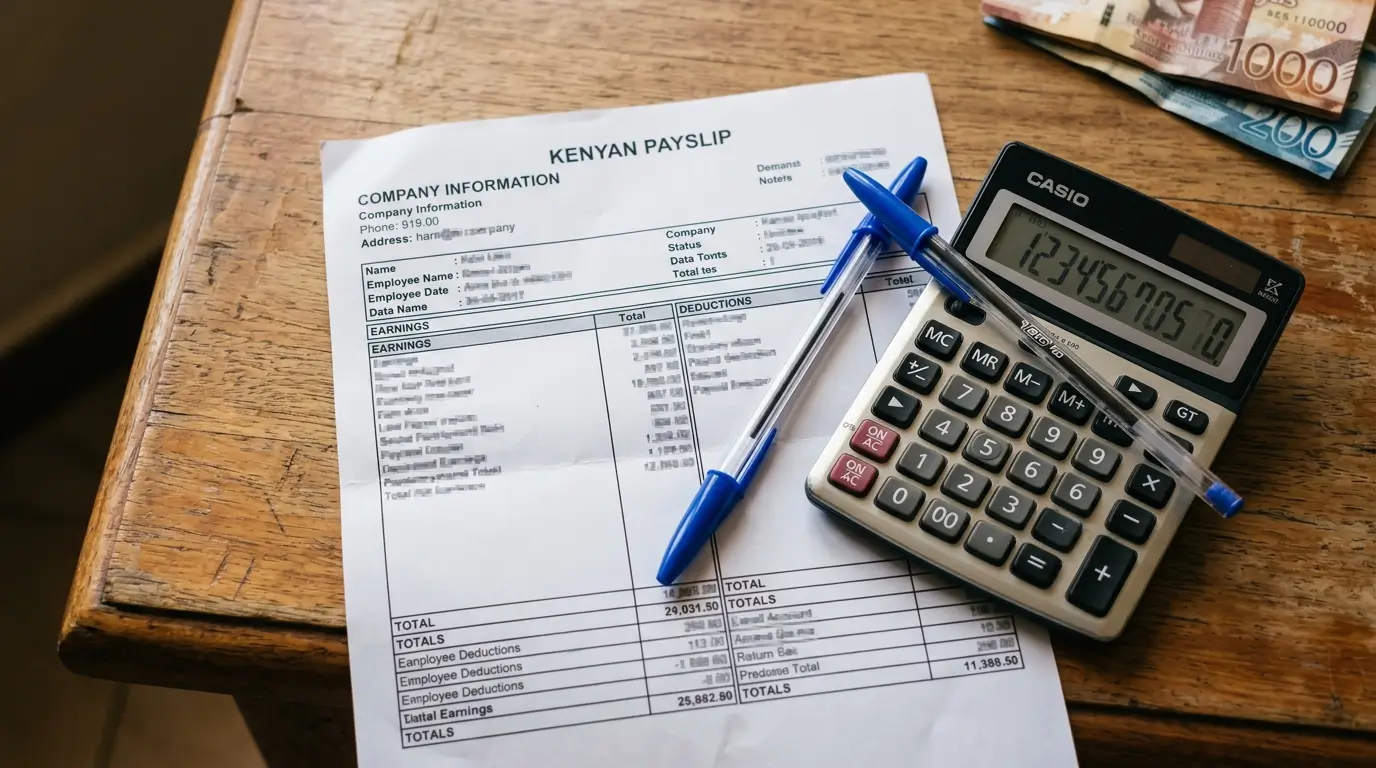
Four numbers separate your gross salary from what actually lands in your account: NSSF, SHIF, the Affordable Housing Levy, and PAYE. Each is a fixed percentage of your pay, each is calculated in a specific order, and three of the four have changed since 2023. Net pay smaller than it was last year, and no obvious reason why? The answer is almost always sitting in one of these four lines.
This guide works through each deduction using the rates in force for 2026, shows two full salaries run through the maths, flags the errors that show up most often on real payslips, and points to the official sources behind every figure.
The Fundamental Components of a Kenyan Payslip
A Kenyan payslip has three layers: earnings, deductions, and net pay. Earnings combine into gross pay; deductions split into four statutory ones and whatever voluntary ones apply to a given employee; what's left is net pay.
Gross pay is basic salary plus taxable allowances: housing, transport, commuter, hardship, and similar cash payments added on top of basic pay. Non-cash benefits, a company car or subsidised housing, get added in for tax purposes even though no cash changes hands.
Statutory deductions are the four covered in this guide, and every employer is required to apply them in the same order: NSSF, then SHIF, then the Affordable Housing Levy, all calculated on gross pay, followed by PAYE on whatever remains after those three. Personal relief then reduces the PAYE figure itself, rather than the pay it was calculated from.
Voluntary deductions come after that and vary by employer and employee: SACCO contributions, HELB loan repayments, union dues, a pension scheme on top of NSSF, a staff welfare fund. None of these are required by law, so they won't appear on every payslip, and they come off net pay rather than affecting how PAYE is worked out. Anyone still repaying a student loan through check-off can work out the monthly instalment with the HELB Loan Calculator Kenya.
What's left after all of it is net pay, the figure that actually reaches a bank account or M-Pesa line.
Understanding Pay As You Earn (PAYE) Income Tax in Kenya
PAYE is the income tax withheld from salary each month under the Income Tax Act, Cap 470, calculated on taxable income: gross pay after NSSF, SHIF, and the Housing Levy have already come off, covered in the next three sections.
Every employer registered with KRA has to deduct PAYE and remit it through iTax by the 9th of the following month. The obligation sits with the employer, not the employee: if an employer deducts PAYE but fails to remit it, or simply forgets to deduct it, KRA holds the employer liable for the tax plus penalties, not the worker, and those penalties compound the way the KRA Penalty & Interest Calculator works out for any late statutory payment. Kenya uses five progressive bands, set by the Finance Act 2023 and unchanged since:
| Monthly taxable income | Rate |
|---|---|
| First KES 24,000 | 10% |
| Next KES 8,333 (24,001–32,333) | 25% |
| Next KES 467,667 (32,334–500,000) | 30% |
| Next KES 300,000 (500,001–800,000) | 32.5% |
| Above KES 800,000 | 35% |
Only the portion of income inside each band is taxed at that band's rate. Someone with KES 40,000 of taxable income doesn't pay 30% on the whole amount; they pay 10% on the first 24,000, 25% on the next 8,333, and 30% on the remaining 7,667 only. Working out where a specific salary lands across these bands is quicker with the PAYE Calculator Kenya 2026 than doing it by hand.
Two reliefs reduce the tax bill after it's calculated. Personal relief is automatic: KES 2,400 a month, or KES 28,800 a year, for every resident employee, regardless of income. Insurance relief has to be claimed, and covers 15% of premiums paid on qualifying life or education policies, up to KES 5,000 a month or KES 60,000 a year; SHIF doesn't qualify, since it's already deducted before PAYE is worked out rather than paid from taxed income.
A certified person with disability gets a separate benefit entirely: the first KES 150,000 of monthly pay is exempt from PAYE outright, under the Persons with Disabilities Act, 2003, once KRA has issued the exemption certificate.
The Social Health Insurance Fund (SHIF) Contribution Explained
SHIF charges 2.75% of gross pay, with a floor of KES 300 and no ceiling. It replaced NHIF's old banded table on 1 October 2024.
The Social Health Insurance Fund, run by the Social Health Authority, dropped NHIF's approach of one fixed amount per salary bracket. The deduction now moves in a straight line with pay: earn more, pay more, with nothing capping the top the way NHIF's old table eventually did. The 2.75% only bites once gross pay passes about KES 10,909 a month; below that, the KES 300 minimum applies instead, so someone on KES 8,000 pays the same SHIF as someone on KES 10,000. SHIF is remitted by the 9th of the following month, the same deadline as PAYE and the housing levy. The SHIF Calculator Kenya applies the 2.75% rate and the minimum automatically for any gross figure.
National Social Security Fund (NSSF) Contributions and Benefits
NSSF splits pensionable pay into two bands, Tier I and Tier II, and charges 6% on each, matched by the employer. From February 2026 the bands widened, so most salaried Kenyans above KES 9,000 a month now pay more into NSSF than they did in January.
Tier I covers pay up to the lower earnings limit. That limit moved from KES 8,000 to KES 9,000 in February 2026, the fourth of five scheduled increases under the NSSF Act, No. 45 of 2013. Tier II covers pay above that, up to the upper earnings limit, which rose at the same time from KES 72,000 to KES 108,000. Past KES 108,000, nothing extra gets deducted; NSSF is capped there.
Take someone earning KES 45,000 a month. Tier I is 6% of the first 9,000, which is 540. Tier II is 6% of the next 36,000, the gap between 9,000 and their salary, which is 2,160. Add the two and their NSSF deduction is 2,700, matched by another 2,700 from their employer. Someone earning KES 150,000 pays the same NSSF as someone on KES 108,000, because Tier II stops growing at the cap: 540 plus 6% of 99,000, or 5,940, for a maximum monthly deduction of KES 6,480. The NSSF Calculator Kenya 2026 runs both tiers automatically for any salary, current or backdated to earlier rate periods.
NSSF isn't just a deduction line; it funds five categories of benefit once a member stops contributing. The retirement age benefit pays out at the statutory retirement age of 60. The withdrawal benefit lets a member access their savings from age 50, once they've left formal employment, without waiting until 60. The invalidity benefit covers permanent inability to work, certified through medical assessment. The survivors' benefit pays a member's dependents if they die while still contributing. The emigration benefit covers members leaving Kenya permanently for a country outside the East African Community. Each is paid out through an NSSF office, against the accumulated Tier I and Tier II contributions built up over a working life, plus the investment returns on that balance.
The Affordable Housing Levy Deduction and Its Purpose
The levy takes 1.5% of gross pay, matched by another 1.5% from the employer, with no minimum and no cap. The Housing Levy Calculator Kenya shows both the employee deduction and the employer's matching contribution side by side.
It first appeared under the Finance Act 2023, was struck down by the courts for skipping public participation, and came back the following year as its own law: the Affordable Housing Act, 2024, in force since March 2024. The money funds the government's affordable housing programme, including units allocated through the Boma Yangu portal. On a payslip, the levy shows up as one line equal to 1.5% of gross pay; the employer's matching 1.5% never appears there, since it comes out of the employer's own budget, not the employee's pay.
Contributing doesn't buy an automatic house. It funds the wider programme, and a Kenyan looking to buy a unit still registers separately through Boma Yangu, saves a deposit, and goes through the same allocation process as any other applicant.
Calculating Your Net Pay from Gross Salary with Deductions
Put the four deductions together and two things become clear: how much of a salary actually reaches an employee, and how differently that plays out at different income levels. Two worked examples show both ends; the Net Pay Calculator Kenya 2026 does the same maths instantly for any gross figure, and the Gross Pay Calculator Kenya 2026 works the other direction, from a target net pay back to the gross salary needed to reach it.
A full example: gross pay of KES 80,000
Start with gross pay of KES 80,000.
NSSF comes to 540 for Tier I, plus 6% of 71,000 for Tier II, which is 4,260. Total: 4,800. SHIF is 2.75% of 80,000, or 2,200. The housing levy is 1.5% of 80,000, or 1,200. Subtract all three from gross pay and taxable income comes to 71,800.
Run that through the bands: 2,400 on the first 24,000, 2,083.25 on the next 8,333, and 11,840.10 on the remaining 39,467. That's 16,323.35 in tax before relief. Subtract the 2,400 personal relief and PAYE lands at KES 13,923.
Net pay is 80,000 minus 4,800, minus 2,200, minus 1,200, minus 13,923, which comes to KES 57,877. The employer, meanwhile, pays more than the 80,000 shown on the payslip: matching NSSF (4,800) and the housing levy (1,200) push the real cost of that salary to roughly KES 86,000 a month.
A second example: why some payslips show zero PAYE
At lower salaries, personal relief can wipe out the entire PAYE bill even though tax is technically calculated on the income.
Take gross pay of KES 20,000. NSSF is 540 for Tier I plus 6% of 11,000 for Tier II, which is 660, for a total of 1,200. SHIF is 2.75% of 20,000, or 550, above the 300 minimum. The housing levy is 1.5% of 20,000, or 300.
Taxable income comes to 17,950, all inside the first 10% band, so tax before relief is 1,795. Personal relief is 2,400, more than the tax owed, so PAYE drops to zero rather than going negative; there's no refund for the difference. Net pay is 20,000 minus the 2,050 in NSSF, SHIF, and housing levy, which is KES 17,950—identical to taxable income, because nothing was left to tax away.
Common Payslip Errors and How to Address Them
Most payslip errors come from applying a deduction to the wrong base, using an outdated rate, or getting the calculation order wrong. All of them are checkable against the numbers in this guide.
A few mistakes turn up more than others:
- NSSF or SHIF calculated on basic pay instead of gross pay, which understates both deductions and, indirectly, overstates taxable income, since NSSF and SHIF are what reduce it in the first place.
- Tier I and Tier II limits left at the old figures after a February rate change, so NSSF comes out wrong for anyone earning above the previous lower limit.
- SHIF applied using NHIF's old banded table instead of the flat 2.75% rate, a holdover from payroll systems never updated after October 2024.
- Insurance relief claimed against SHIF contributions, which KRA doesn't allow, since SHIF is already a pre-tax deduction.
- The Housing Levy calculated on basic pay only, leaving out allowances that should be part of the base.
Any of these is worth raising with payroll or HR directly, with the specific rate or figure that looks wrong. If the employer won't correct it, the next step is KRA itself: an employee can log into iTax, check the PAYE actually remitted against their P9 form, and file a query through the portal if the numbers don't match what was deducted from their pay.
Resources for Further Information on Kenyan Tax and Social Security
Five official sources cover everything in this guide, straight from the bodies that set and collect these deductions.
- Kenya Revenue Authority (kra.go.ke)—PAYE guidance, iTax, and the current tax bands and reliefs, including the disability exemption.
- NSSF Kenya (nssf.or.ke)—contribution rates, the self-service portal, and benefit claims.
- Social Health Authority (sha.go.ke)—SHIF registration and contribution rules.
- Boma Yangu (bomayangu.go.ke)—registration for the Affordable Housing Programme and unit allocation.
- Kenya Law (kenyalaw.org)—the full text of the Income Tax Act, the NSSF Act 2013, the Social Health Insurance Act 2023, and the Affordable Housing Act 2024, for anyone who wants the actual legislation rather than a summary of it.
For a faster check than reading legislation, the Net Pay Calculator Kenya 2026 applies all four deductions to any gross salary in a few seconds, using the same 2026 rates covered here.